
Our network
A nationwide fulfillment network we operate and answer for
Your inventory ships from facilities we operate, run by our own people, not a patchwork of subcontractors, and it reaches 99.77% of the US in 1-3 days by ground.
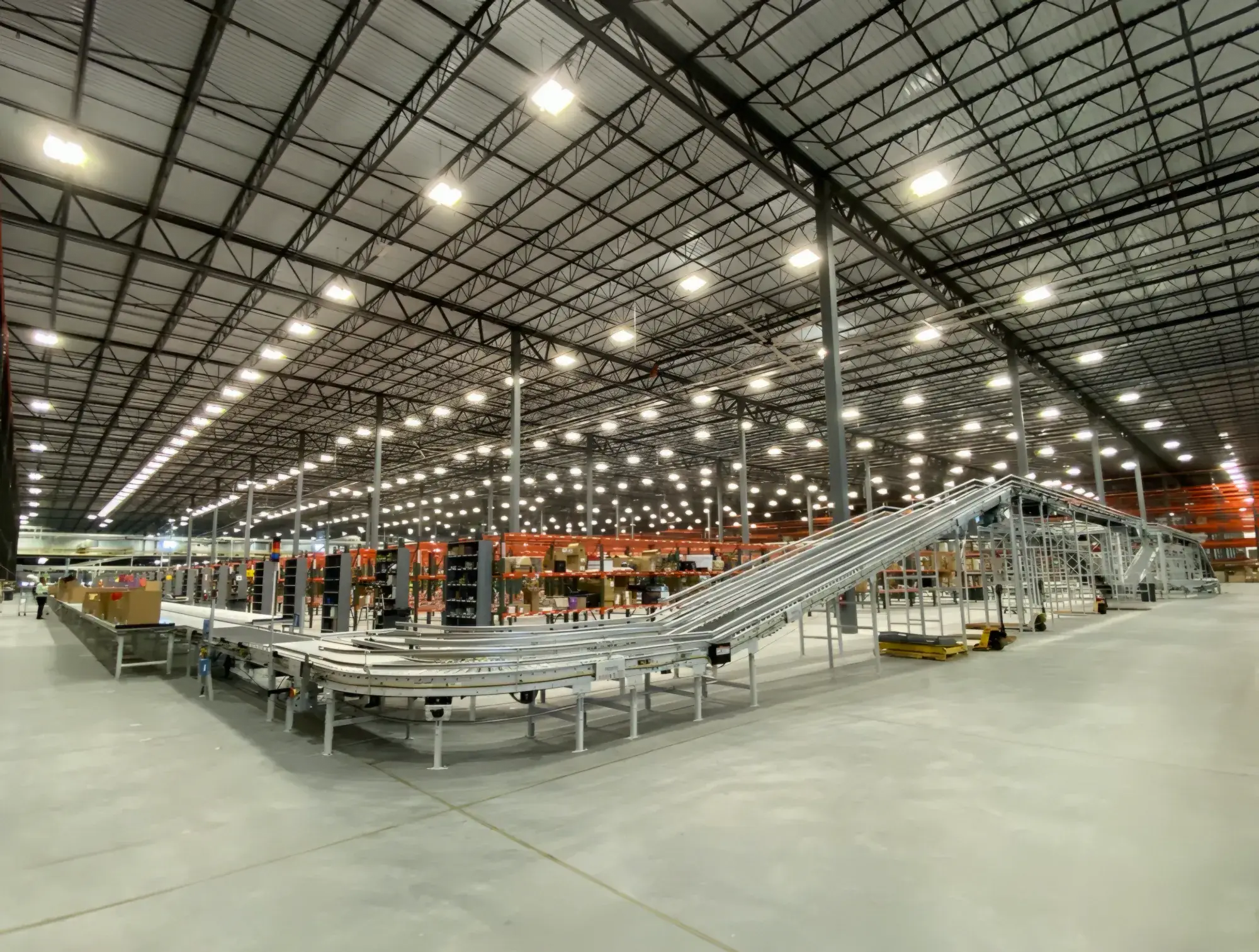
Operated across North America
Every node on the map is a building we run.
We operate your fulfillment as a third-party-logistics provider (3PL). Our own procedures and our own supervision run the floor at every North American node, so the standard your orders are held to does not change with the address they ship from.
of the US reached in 1-3 days by ground
Published reach, used as-is
One team
Across the network
Our buildings, our procedures, our supervision
Barcode-verified
Order accuracy
The right item to the right address
How it works
How a multi-node network ships orders from the node closest to your customer
The network is not many warehouses for their own sake. It is one distributed-inventory model: split a brand's stock across multiple Fulfillment.com nodes and each order ships from the facility closest to its destination, which makes 1-3 day ground the default instead of the exception.
- 1
Place stock where demand is
You can position inventory across our nodes by where your customers actually are, so the average order starts close to its destination. We will show you what your own order history says about where it should sit.
- 2
Route each order to the closest node
BestOMS routes each order to the facility we run nearest the ship-to address. The order leaves from the shortest reasonable distance, not from a single central warehouse.
- 3
Ship the short hop by ground
A shorter origin-to-destination distance is a lower shipping zone, which is what turns 1-3 day ground into the everyday method instead of paid air upgrades.
- 4
One platform behind all of it
Every node runs on the same software. BestOMS runs your orders and gives you one portal to watch them on, and Deposco runs the warehouse floor behind it. Distributed inventory does not mean distributed visibility: one stock position, one order pipeline, across the whole network.
The right product reaches the right customer: every pick is barcode-verified against the order before the box is sealed, so the scan is what releases a unit, not a picker reading a label at speed. Stock is in many places, but accountability and visibility stay in one. See the technology that routes and unifies the nodes.
Zone reduction
Closer stock means lower zones, lower cost, faster transit
Carriers price ground shipments by zone, the distance band between origin and destination. Storing a brand's inventory near its customers lowers the average zone the brand ships into, and a lower average zone is both a lower per-parcel cost and a shorter transit time. The distributed-inventory model exists to pull the average zone down.
Lower zones lower cost
Each zone closer to the customer is a cheaper ground rate on the same parcel. Across a brand's order volume, shifting the average zone down compounds into real freight savings, the same parcels moving at lower zones order after order.
Lower zones cut transit
A lower zone is fewer ground days in transit, so distributing inventory reduces reliance on expensive expedited air to hit a 1-3 day promise.
The reach proof closes the loop
Zone reduction is not a theoretical lever. It is the mechanism behind the published reach, applied order by order, not a number on a page.
Transit times & zones
Pick your warehouses. See the combined coverage.
Select one or more nodes to see combined coverage across the contiguous US in fine detail. Toggle between ground transit time and shipping zone.
Node locations are real Fulfillment.com facilities. Transit tiers reflect the faster of FedEx Home Delivery or UPS Ground, with destinations either carrier defers counted a day slower. Shipping zones reflect FedEx Home Delivery.
Select your fulfillment nodes
Ground transit
* Population: US Census Bureau, American Community Survey 2024 5-year estimates (2020-2024). This product uses the Census Bureau Data API but is not endorsed or certified by the Census Bureau.
Opening Q4 2026 · Indianapolis
250 millionpeople* will be within two ground days of one new building in Indianapolis, from the day it opens
57 million
One ground day · 17.05% of the US
250 million
Two ground days · 75.24% of the US
319 million
Three ground days · 96.01% of the US
| Band | Share of the contiguous US population | People |
|---|---|---|
| One ground day | 17.05% | 57 million |
| Two ground days | 75.24% | 250 million |
| Three ground days | 96.01% | 319 million |
Indianapolis sits inside a ground day of the Ohio Valley, the Great Lakes and the Northeast corridor, the densest stretch of the country. Whether that helps you depends on where your own orders go, and no national figure answers that. We run a shipping analysis against a brand's real destination mix to find which of our facilities suits it. Ask for one when you talk to us.
Indianapolis is not shipping yet; it goes live Q4 2026. These figures are what it would reach by itself, not what the network reaches: every coverage figure published elsewhere on this site is the network as it runs today, with Indianapolis excluded from it. * Population: US Census Bureau, American Community Survey 2024 5-year estimates (2020-2024), contiguous US: the same source and denominator the transit map above uses. This product uses the Census Bureau Data API but is not endorsed or certified by the Census Bureau.
Where the network is
A named set of nodes, each with a role in the coverage design
The network is a named, geographically organized set of nodes with a per-node role, not a single facility or an abstract nationwide claim. Each node's city, region, and role in the coverage design are shown below.
West Coast
Fresno, CA
West Coast node for fast California and Pacific-region coverage.
Midwest
Kansas City, MO
Central node that balances ground transit toward both coasts.
Indianapolis, IN
Eastern Midwest node, going live Q4 2026. It sits inside a ground day of the Ohio Valley, the Great Lakes, and the Northeast corridor: shipping on its own it would reach 75.24% of the US population within two ground days.
Southeast
Atlanta, GA
Inland Southeast node reaching the East Coast and Gulf fast.
Southeast
Savannah, GA
Port-adjacent Southeast node positioned for import flow and East Coast distribution.
Northeast
Harrisburg, PA
Mid-Atlantic node anchoring the dense Northeast corridor.
Canada
Mississauga, ON
Greater Toronto Area node serving the Canadian market.
Per-node square footage, dock and truck doors are shared on request during a facility review.
Beyond North America
International reach through vetted 4PL partners
Beyond North America, you work the same way you always do: one BestOMS view, the same team answering for your orders. What changes is who runs the building. These locations are operated by vetted fourth-party-logistics (4PL) partners rather than by us, which is why we list them apart from the nodes we run ourselves.
4PL partner
Birmingham, UK
UK and European fulfillment through a vetted 4PL partner.
4PL partner
Neuwied, Germany
Central-European fulfillment through a vetted 4PL partner.
4PL partner
Melbourne (Dandenong South), Australia
Australian and Asia-Pacific (APAC) fulfillment through a vetted 4PL partner.
Partner-operated international locations. The "one operator owns it all" model describes the North American network we operate ourselves.
The footprint behind the reach
Concrete capacity proof, per node and across the network
The reach and the node map are backed by capacity at two levels: per-node (square footage, dock/truck doors, highway positioning) and aggregate (total node count and total network square footage).
Square footage
Each node holds the storage and throughput capacity its region's volume needs, sized to the orders it ships.
Dock and truck doors
Dock and truck doors at each node keep inbound receiving and outbound carrier pickups moving without bottlenecks.
Highway positioning
Nodes sit near major highway interchanges, so trucks reach the carrier network quickly and orders start moving sooner.
Your inventory is received, counted, and shelf-ready within moments of arrival, because being out of stock is never okay.
Carrier scale
The carrier relationships the network ships on
The network's reach depends on carrier breadth, and our volume gives the brand access to multi-carrier ground capacity and rates a single-node shipper cannot reach on its own.
Our own shipping volume earns broad carrier relationships and rate leverage across the network. Each order is routed to the carrier and service level that hits the 1-3 day ground promise at the lowest reasonable cost from the closest node.
Orders move across multiple ground carriers rather than being locked to a single contract.
See if our network fits
Tell us your product, volume, and primary destination regions, and we'll show you how multi-node coverage changes your reach. Real proof: 1-3 day ground to 99.77% of the US.